Bayes' Theorem and Base Rates
Install and import#
npm install fintech-algorithmsimport { bayesTheoremAndBaseRates } from "fintech-algorithms/foundations/probability-and-random-variables/bayes-theorem-and-base-rates";Signature#
bayesTheoremAndBaseRates(input)Turns a prior, a true-positive rate, and a false-positive rate into the posterior probability of the condition given a positive result, along with the unconditional probability of that result.
Parameters#
| Name | Type | Notes |
|---|---|---|
input | { prior: number; sensitivity: number; falsePositiveRate: number; pA?: number; pB?: number; pAB?: number } | prior is the base rate of the condition, sensitivity the chance of a positive result when the condition holds, and falsePositiveRate the chance of a positive result when it does not. Those three fields are the whole input. The shared F06 branch also validates the family-wide pA, pB and pAB before any topic runs; Bayes uses none of them, so the topic facade fills them with zero when they are absent. They may still be supplied, and are validated when they are.prior: 0 <= prior <= 1 · sensitivity: 0 <= sensitivity <= 1 · falsePositiveRate: 0 <= falsePositiveRate <= 1 · pA: optional; 0 <= pA <= 1 when supplied, otherwise 0 · pB: optional; 0 <= pB <= 1 when supplied, otherwise 0 · pAB: optional; 0 <= pAB <= min(pA, pB) when supplied, otherwise 0 |
Returns#
{ posterior: number; evidenceProbability: number }
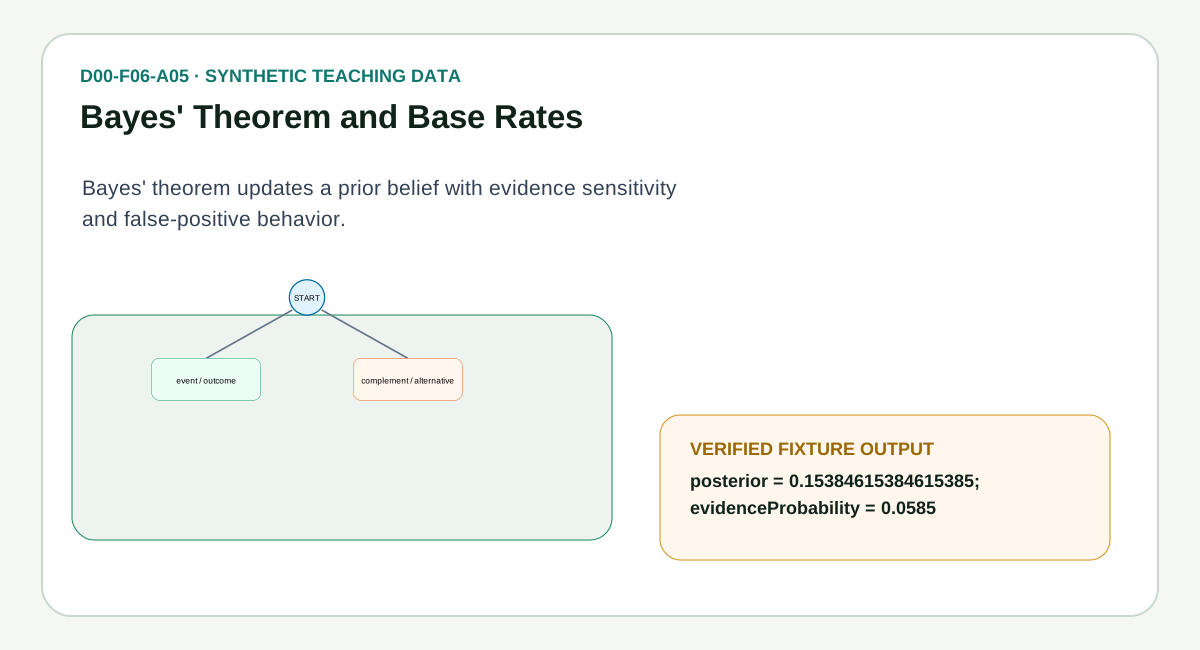
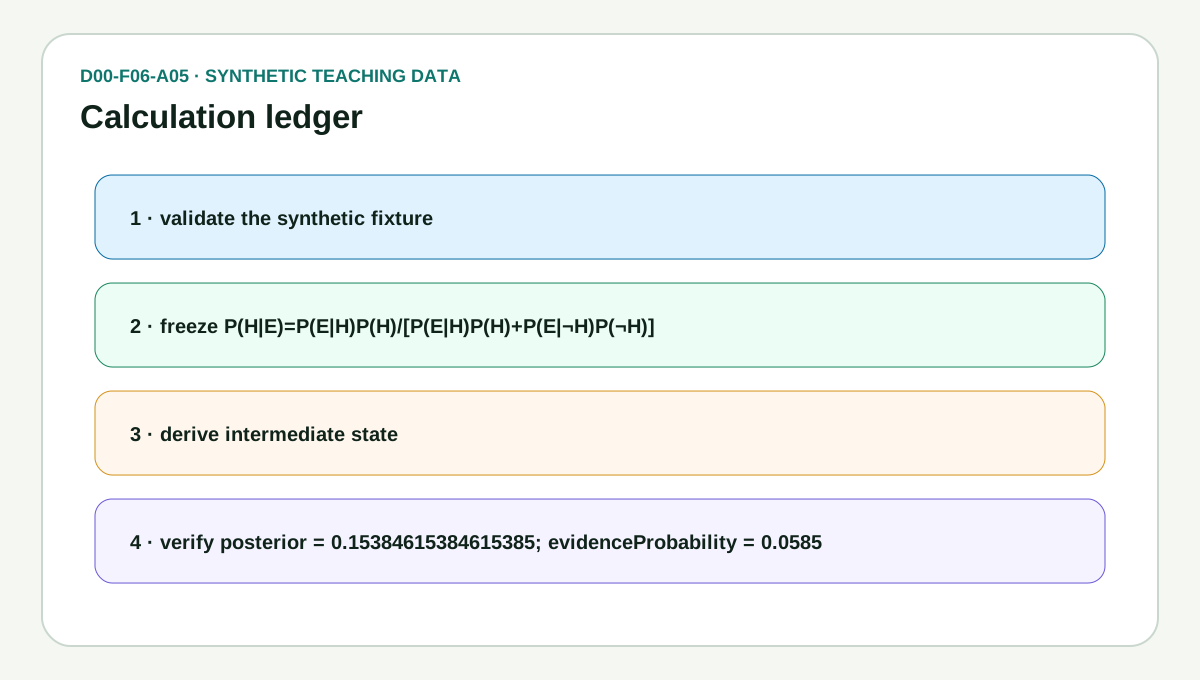
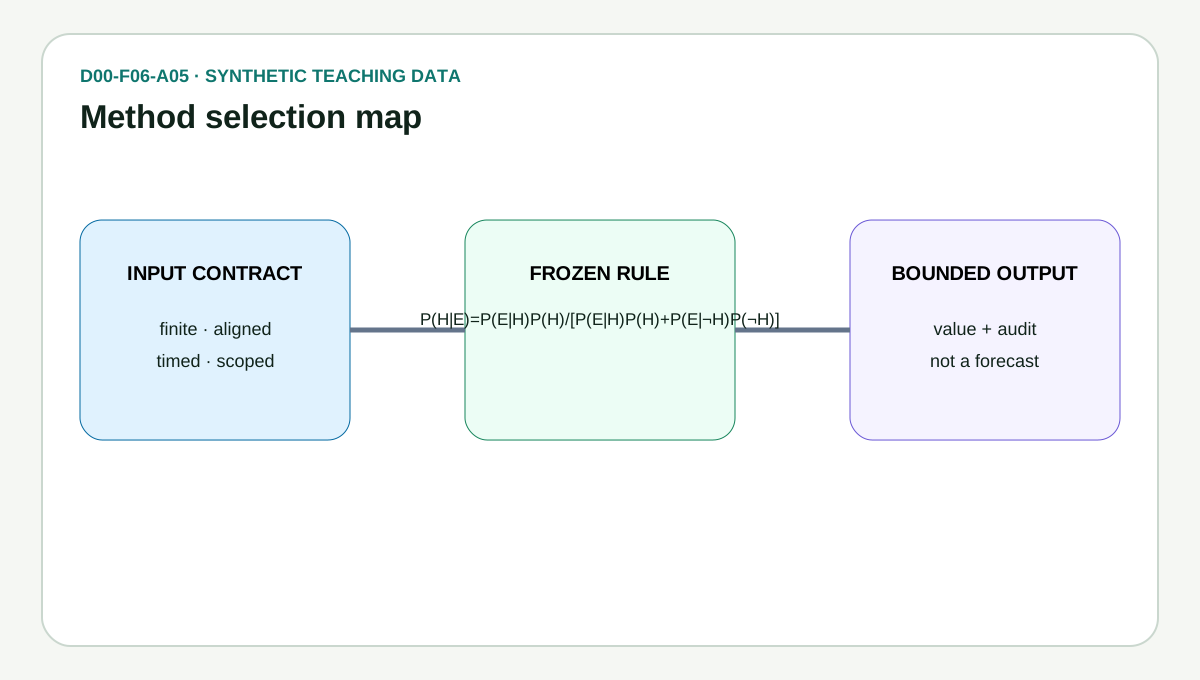
evidenceProbability is sensitivity * prior + falsePositiveRate * (1 - prior), the total chance of a positive result, and posterior is sensitivity * prior divided by it.
Errors#
- When
inputis null, an array, or not an object — throws TypeError - When a supplied
pA,pB, orpABfalls outside [0, 1], orpABexceedsmin(pA, pB)— throws RangeError - When
prior,sensitivity, orfalsePositiveRatefalls outside [0, 1] — throws RangeError - When the evidence probability works out to exactly zero, leaving the posterior undefined — throws RangeError
Complexity: time O(1),
space O(1).
Worked example#
verified This is the worked example published in the article, replayed by the test suite on every run. The output cannot drift.
Input#
{
  "prior": 0.01,
  "sensitivity": 0.9,
  "falsePositiveRate": 0.05
}Call#
bayesTheoremAndBaseRates(input)Returns#
object with 2 fields: posterior, evidenceProbability
{
  "posterior": 0.15384615384615385,
  "evidenceProbability": 0.0585
}Diagrams#
Calculation flow#
Reasoning flow — D00-F06-A05
flowchart LR
    A["Synthetic input + metadata"] --> B{"Contract valid?"}
    B -->|No| C["Reject or route with reason"]
    B -->|Yes| D["Apply Bayes' Theorem and Base Rates"]
    D --> E["Formula: P(H|E)=P(E|H)P(H)/[P(E|H)P(H)+P(E|¬H)P(¬H)]"]
    E --> F["Verified fixture output"]
    F --> G{"Interpretation within boundary?"}
    G -->|Yes| H["Report value + convention + audit"]
    G -->|No| I["Add companion view or narrower claim"]
How it works#
This page states the contract — how to call it correctly. The article explains the concept: why it works, and where it breaks.
References#
- Probability Distributions — NIST/SEMATECH e-Handbook
- Probability Distributions — SciPy User Guide
- Historical-example decision