Hilbert Transform Trend/Cycle Mode
Install and import#
npm install fintech-algorithmsimport { hilbertTransformTrendCycleMode } from "fintech-algorithms/statistical-time-series/hilbert-and-ehlers-cycle-analytics/hilbert-transform-trend-cycle-mode";Signature#
hilbertTransformTrendCycleMode(input)Labels each bar trend or cycle by asking whether the distance from close to its exponential trend exceeds 1.5 times the current Hilbert phasor amplitude. Any contract failure is rethrown as an Error whose message begins topic calculation failed: .
Parameters#
| Name | Type | Notes |
|---|---|---|
input | TopicInput | bars is a non-empty array of rows with timestamp, open, high, low, close and volume, strictly ordered by timestamp. This topic genuinely uses parameters.period, which defaults to 20 and must be an integer of at least 4; it is the span of the close EMA that supplies the trend series. |
Returns#
TopicResult
Three series, each mirrored in latest: mode is the text trend or cycle, trend is the EMA of close over period, and amplitude is the Hilbert phasor magnitude. parameters echoes the supplied parameters and diagnostics reports causal and input_count. The series have different warm-ups and ready_at follows the earliest of them, 6.
Warm-up#
The first 6 nulls for `amplitude`, and `period - 1` nulls for `trend` and `mode` (19 at the default period of 20) positions are . amplitude needs the 4-bar EMA of close plus three bars of the quadrature filter, so it starts at index 6 and sets ready_at to 6. trend is an EMA seeded from the first full window of period closes, so it starts at index period - 1, and mode needs both, so it starts with trend.
Errors#
- When
parameters.periodis present but is not an integer of at least 4 — throws Error - When
barsis empty, atimestampis missing or not strictly increasing, an OHLCV field is not finite,volumeis negative, orhighandlowdo not bracketopenandclose— throws Error
Complexity: time O(n),
space O(n).
Worked example#
executed Captured by running this function on the input its own test provides. Real output of real code — but not asserted against a published figure.
Input#
{
  "bars": [
    {
      "timestamp": "2024-01-02",
      "basis": "synthetic-unadjusted",
      "open": 100,
      "high": 101.45,
      "low": 98.695,
      "close": 100,
      "volume": 750000,
      "benchmark": 200
    },
    {
      "timestamp": "2024-01-03",
      "basis": "synthetic-unadjusted",
      "open": 101.49111452,
      "high": 103.38381693,
      "low": 100.05480022,
      "close": 101.78791214,
      "volume": 795117,
      "benchmark": 200.56326135
    },
    {
      "timestamp": "2024-01-04",
      "basis": "synthetic-unadjusted",
      "open": 102.45519048,
      "high": 104.6701838,
      "low": 100.91147007,
      "close": 102.9549389,
      "volume": 840234,
      "benchmark": 201.11020913
    }
  ],
  "parameters": {}
}Call#
hilbertTransformTrendCycleMode(input)Returns#
object with 9 fields: topic_id, title, state, ready, ready_at, series, latest, parameters, …
{
  "topic_id": "D09-F06-A05",
  "title": "Hilbert Transform Trend/Cycle Mode",
  "state": "calculated",
  "ready": true,
  "ready_at": 6,
  "series": {
    "mode": [null, null, null, null, null, null],
    "trend": [null, null, null, null, null, null],
    "amplitude": [null, null, null, null, null, null]
  },
  "latest": {
    "mode": "trend",
    "trend": 103.9546773984291,
    "amplitude": 0.8769323358697945
  },
  "parameters": {},
  "diagnostics": {
    "causal": true,
    "input_count": 96
  }
}Diagrams#
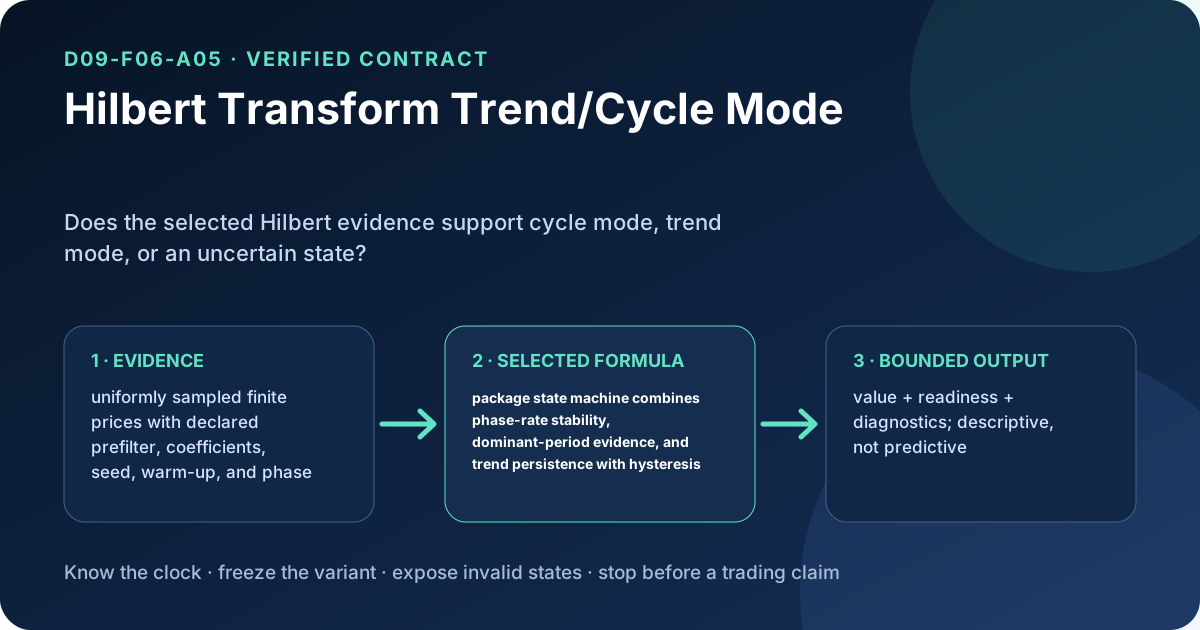
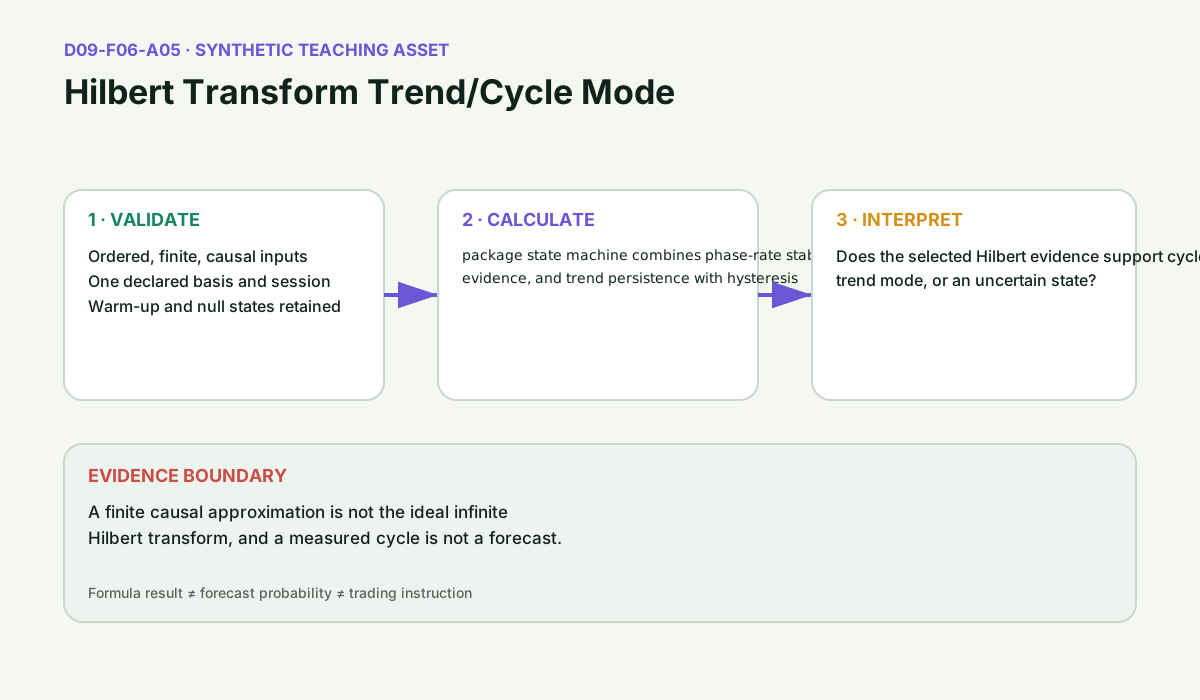
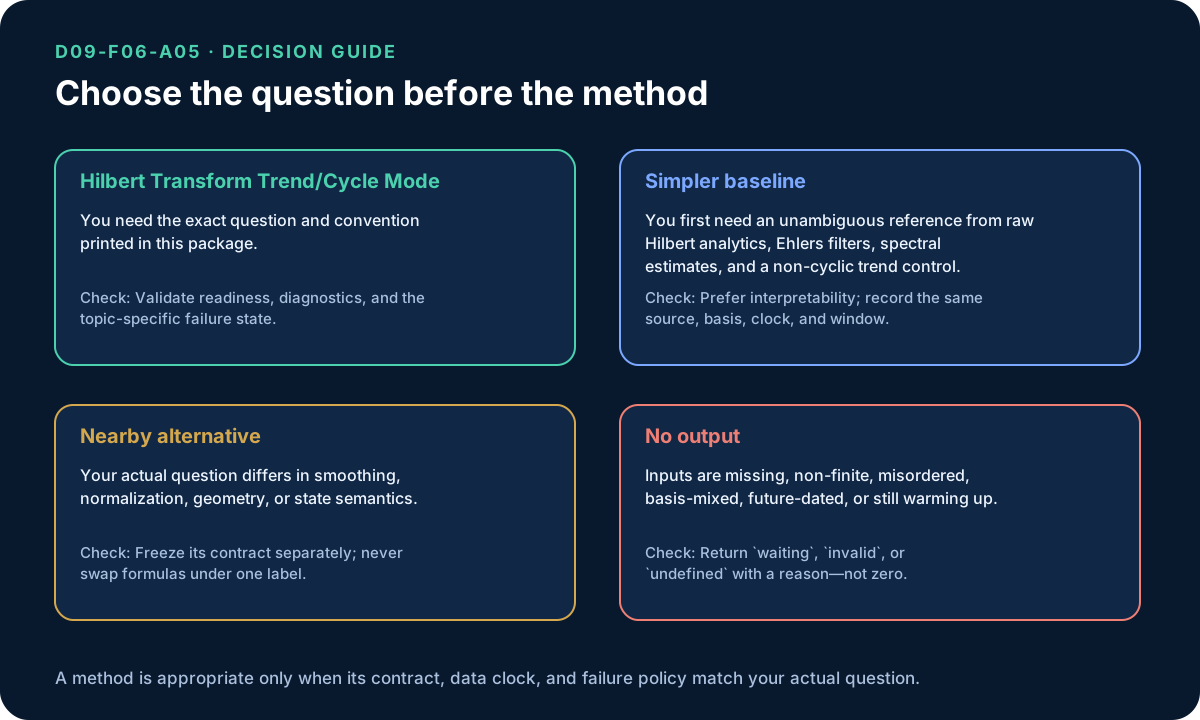
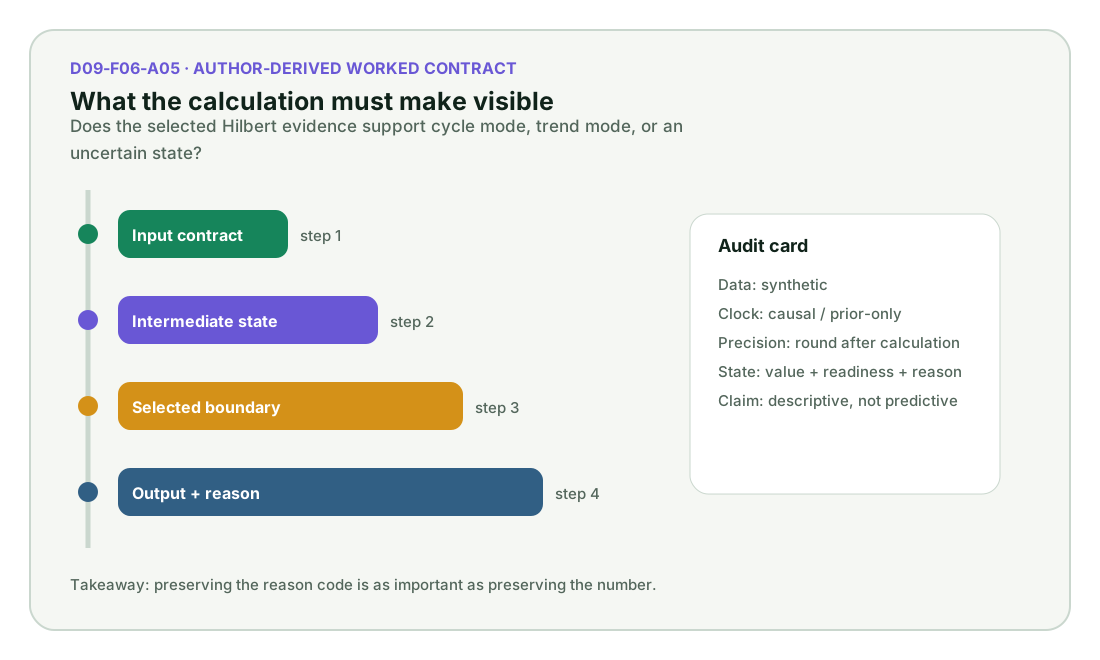
Calculation flow#
Hilbert Transform Trend/Cycle Mode calculation flow
flowchart LR
    A["uniformly sampled finite prices with declared prefilter, c"] --> B["Validate order, basis, and finite values"]
    B --> C["Apply the selected Hilbert Transform Trend/Cycle Mode convention"]
    C --> D["Emit value, readiness, and diagnostics"]
    D --> E["Interpret descriptively; test outcomes separately"]
    B -->|invalid or insufficient| X["Withhold output with a reason"]
Hilbert Transform Trend/Cycle Mode readiness and evidence states
stateDiagram-v2
    [*] --> Waiting
    Waiting --> Ready: enough valid causal observations
    Waiting --> Rejected: malformed or unsupported input
    Ready --> Calculated: selected formula applied
    Calculated --> Interpreted: diagnostic and limitation retained
    Interpreted --> Ready: next observation arrives
    Rejected --> Waiting: corrected input and deterministic reset
How it works#
This page states the contract — how to call it correctly. The article explains the concept: why it works, and where it breaks.
References#
- TA-Lib cycle indicator group — TA-Lib project contributors
- SciPy analytic-signal documentation — The SciPy community
- TA-Lib maintained source — TA-Lib project contributors
- Evidence decision
- Level 1 evidence map