Refresh-Time Sampling
Install and import#
npm install fintech-algorithmsimport { refreshTimeSample } from "fintech-algorithms/market-data-engineering/time-synchronization/refresh-time-sampling";Signature#
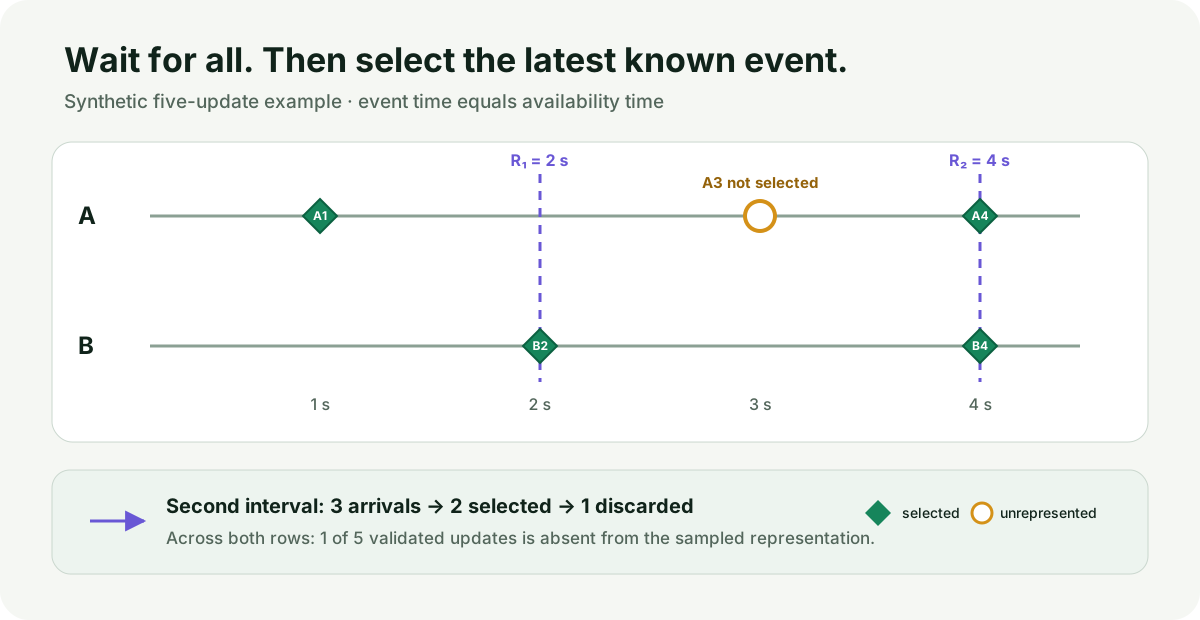
refreshTimeSample(observations, requiredInstruments, maxStalenessMs)Builds a common clock for several instruments by advancing only when every one of them has refreshed. The standard remedy for the bias that non-synchronous trading introduces into correlations.
Parameters#
| Name | Type | Notes |
|---|---|---|
observations | Observation[] | Observations across all instruments, each with partition, instrument, event_time and available_at. |
requiredInstruments | string[] | The instruments that must all have refreshed before a refresh time is emitted. |
maxStalenessMs | number | How old any instrument's value may be at a refresh time. min: 0 |
Returns#
{ rows, partitions }
The synchronised rows, plus per-partition diagnostics showing which instrument was the binding constraint at each step.
Errors#
- When requiredInstruments is empty — throws
Complexity: time O(n log n),
space O(n).
Worked example#
executed Captured by running this function on the input its own test provides. Real output of real code — but not asserted against a published figure.
Input#
[
  {
    "partition": "P1",
    "instrument": "A",
    "record_id": "a1",
    "revision": 0,
    "event_time": "2026-01-01T00:00:01.000Z",
    "available_at": "2026-01-01T00:00:01.000Z",
    "value": 1
  },
  {
    "partition": "P1",
    "instrument": "A",
    "record_id": "a3",
    "revision": 0,
    "event_time": "2026-01-01T00:00:03.000Z",
    "available_at": "2026-01-01T00:00:03.000Z",
    "value": 3
  },
  {
    "partition": "P1",
    "instrument": "A",
    "record_id": "a4",
    "revision": 0,
    "event_time": "2026-01-01T00:00:04.000Z",
    "available_at": "2026-01-01T00:00:04.000Z",
    "value": 4
  }
]
Showing 3 of 5 elements.
["A", "B"]5000Call#
refreshTimeSample(observations, requiredInstruments, maxStalenessMs)Returns#
object with 2 fields: rows, partitions
{
  "rows": [
    {
      "partition": "P1",
      "sequence": 1,
      "previous_refresh_available_at": null,
      "refresh_available_at": "2026-01-01T00:00:02.000Z",
      "controller_instruments": ["B"],
      "status": "accepted",
      "values": {
        "A": 1,
        "B": 20
      },
      "sources": {
        "A": {
          "record_id": "a1",
          "revision": 0,
          "event_time": "2026-01-01T00:00:01.000Z",
          "available_at": "2026-01-01T00:00:01.000Z"
        },
        "B": {
          "record_id": "b2",
          "revision": 0,
          "event_time": "2026-01-01T00:00:02.000Z",
          "available_at": "2026-01-01T00:00:02.000Z"
        }
      },
      "event_age_ms": {
        "A": 1000,
        "B": 0
      },
      "arrivals_by_instrument": {
        "A": 1,
        "B": 1
      },
      "discarded_updates": 0
    },
    {
      "partition": "P1",
      "sequence": 2,
      "previous_refresh_available_at": "2026-01-01T00:00:02.000Z",
      "refresh_available_at": "2026-01-01T00:00:04.000Z",
      "controller_instruments": ["B"],
      "status": "accepted",
      "values": {
        "A": 4,
        "B": 40
      },
      "sources": {
        "A": {
          "record_id": "a4",
          "revision": 0,
          "event_time": "2026-01-01T00:00:04.000Z",
          "available_at": "2026-01-01T00:00:04.000Z"
        },
        "B": {
          "record_id": "b4",
          "revision": 0,
          "event_time": "2026-01-01T00:00:04.000Z",
          "available_at": "2026-01-01T00:00:04.000Z"
        }
      },
      "event_age_ms": {
        "A": 0,
        "B": 0
      },
      "arrivals_by_instrument": {
        "A": 2,
        "B": 1
      },
      "discarded_updates": 1
    }
  ],
  "partitions": [
    {
      "partition": "P1",
      "input_updates": 5,
      "refresh_candidates": 2,
      "accepted_rows": 2,
      "stale_rows": 0,
      "discarded_updates": 1,
      "unmatched_tail_updates": 0,
      "loss_fraction": {
        "numerator": 1,
        "denominator": 5
      }
    }
  ]
}Diagrams#
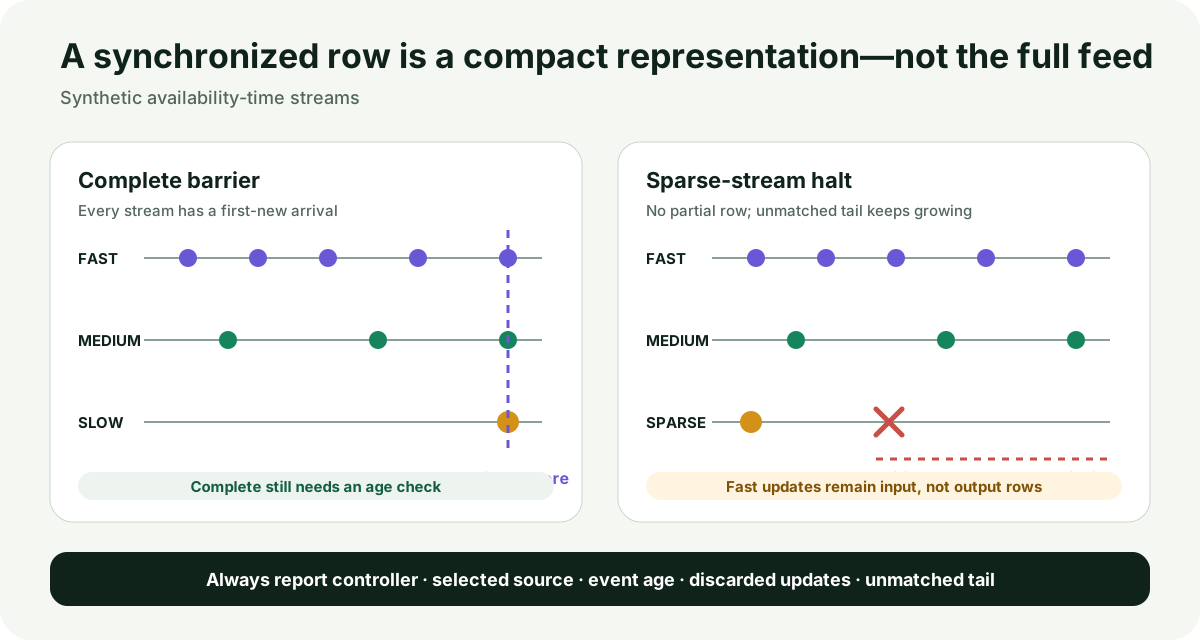
Calculation flow#
Availability-time refresh sequence
sequenceDiagram
    participant A as Fast stream A
    participant B as Medium stream B
    participant C as Sparse stream C
    participant S as Refresh sampler
    A->>S: first new availability A1
    A->>S: later availability A2
    B->>S: first new availability B1
    Note over S: wait, C is missing
    C->>S: first new availability C1
    S->>S: barrier = max(A1, B1, C1)
    S-->>S: select latest known effective event per stream
How it works#
This page states the contract — how to call it correctly. The article explains the concept: why it works, and where it breaks.
References#
- Multivariate realised kernels — Ole E. Barndorff-Nielsen, Peter R. Hansen, Asger Lunde, and Neil Shephard
- On covariance estimation of non-synchronously observed diffusion processes — Takaki Hayashi and Nakahiro Yoshida
- RFC 3339 — Internet Engineering Task Force; Graham Klyne and Chris Newman
- Evidence classification