Concentrated-Liquidity Position
Install and import#
npm install fintech-algorithmsimport { concentratedLiquidityPosition } from "fintech-algorithms/digital-assets-and-on-chain-finance/amm-pricing/concentrated-liquidity-position";Signature#
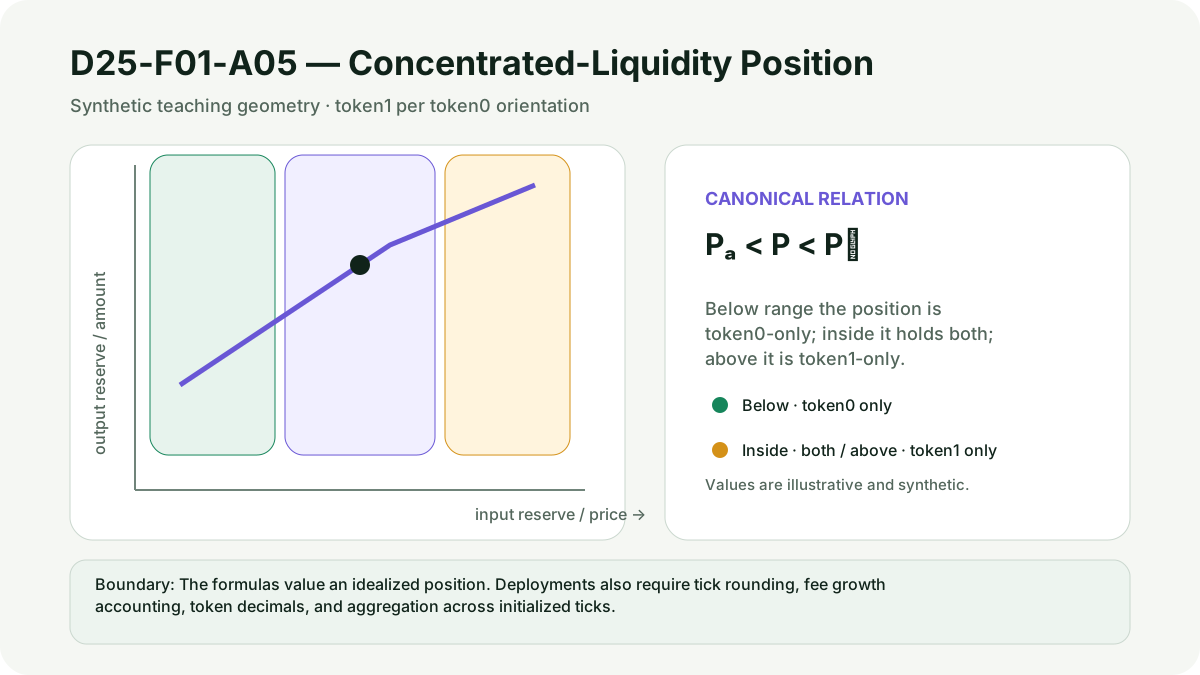
concentratedLiquidityPosition(liquidity, priceLower, priceUpper, currentPrice)Uniswap v3 positions: liquidity supplied only within a price range. Far more capital-efficient inside the range, and entirely one-sided outside it — a position whose price has left its range is holding only the losing asset.
Parameters#
| Name | Type | Notes |
|---|---|---|
liquidity | number | Position liquidity L. min: 0 |
priceLower | number | Lower bound of the range. min: 0 |
priceUpper | number | Upper bound of the range. min: 0 |
currentPrice | number | Current pool price. min: 0 |
Returns#
{ amount0, amount1, inRange, … }
Token amounts held with an explicit in-range flag — out of range is the state that surprises position holders.
Errors#
- When priceLower is not below priceUpper — throws
Complexity: time O(1),
space O(1).
Worked example#
executed Captured by running this function on the input its own test provides. Real output of real code — but not asserted against a published figure.
Input#
10000.811.210.7Call#
concentratedLiquidityPosition(liquidity, priceLower, priceUpper, currentPrice)Returns#
object with 14 fields: model, liquidity, priceLowerToken1PerToken0, priceUpperToken1PerToken0, currentPriceToken1PerToken0, sqrtPriceLower, sqrtPriceUpper, sqrtPriceCurrent, …
{
  "model": "concentrated-liquidity-position",
  "liquidity": 1000,
  "priceLowerToken1PerToken0": 0.81,
  "priceUpperToken1PerToken0": 1.21,
  "currentPriceToken1PerToken0": 0.7,
  "sqrtPriceLower": 0.9,
  "sqrtPriceUpper": 1.1,
  "sqrtPriceCurrent": 0.836660026534,
  "amount0": 202.020202020202,
  "amount1": 0,
  "valueInToken1AtCurrentPrice": 141.414141414141,
  "state": "below-range",
  "active": false,
  "boundaryConvention": "price<=lower is below; lower<price<upper is active; price>=upper is above"
}
Other exports#
This module also exports
constantProductQuote, constantSumQuote, stableSwapInvariant, stableSwapQuote, weightedProductQuote. Every module additionally exports run as an alias of its
primary function, and a meta object carrying its catalog id, domain, family,
shape and article URL.
Diagrams#
Calculation flow#
Diagram
flowchart LR
    A["Normalize balances, amount, and token order"] --> B["Select Concentrated-Liquidity Position contract"]
    B --> C["Apply declared fee convention"]
    C --> D["Solve invariant or piecewise position"]
    D --> E{"Valid state?"}
    E -- "No" --> F["Reject: exhaustion, bounds, or convergence"]
    E -- "Yes" --> G["Update actual balances"]
    G --> H["Compute spot, execution, and diagnostics"]
    H --> I["Report exclusions and state label"]
How it works#
This page states the contract — how to call it correctly. The article explains the concept: why it works, and where it breaks.
References#
- Uniswap v2 Core whitepaper — Uniswap
- StableSwap whitepaper — Curve Finance / Michael Egorov
- Balancer whitepaper — Balancer Labs
- Uniswap v3 Core whitepaper — Uniswap
- Uniswap concentrated-liquidity concept guide — Uniswap Labs
- Source discipline