Keltner Channels
Install and import#
npm install fintech-algorithmsimport { keltnerChannels } from "fintech-algorithms/technical-indicators/volatility-and-channels/keltner-channels";Signature#
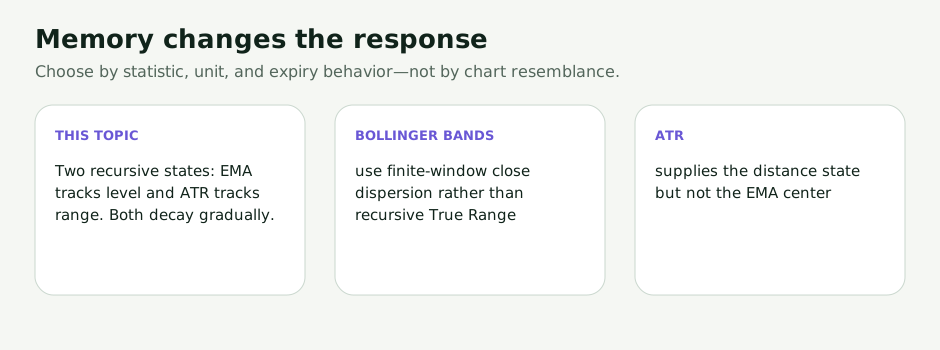
keltnerChannels(high, low, close, emaPeriod, atrPeriod, multiplier)An EMA with bands placed a number of ATRs away. Because it scales with true range rather than standard deviation, it reacts differently to gaps than Bollinger Bands — which is the basis of the squeeze comparison between the two.
Parameters#
| Name | Type | Notes |
|---|---|---|
high | number[] | Per-bar high prices, chronological. |
low | number[] | Per-bar low prices, chronological. |
close | number[] | Per-bar closing prices, chronological. |
emaPeriod | number | Span of the EMA that forms the middle line. min: 1 · integer: true |
atrPeriod | number | Wilder period for the ATR that sets the band width. min: 1 · integer: true |
multiplier | number | Number of ATRs from the middle line to each band. min: 0 |
Returns#
Record<string, (number | null)[]> · length same-as-input
Parallel series: true_range, atr, middle, upper and lower.
Warm-up#
The first max(emaPeriod, atrPeriod) positions are null.
Errors#
- When either period is < 1, is not an integer, or multiplier is negative — throws RangeError
- When the input series are not all the same length — throws RangeError
Complexity: time O(n),
space O(n).
Worked example#
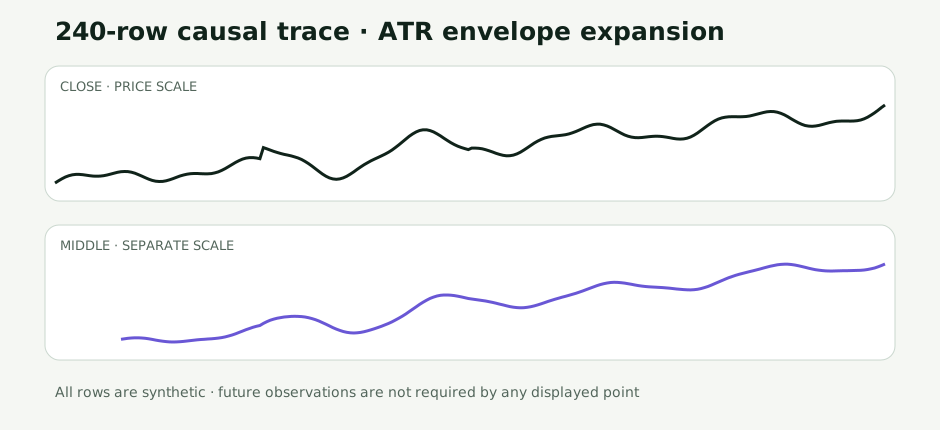
executed Captured by running this function on the input its own test provides. Real output of real code — but not asserted against a published figure.
Input#
[101.08, 101.6243955, 102.13058177, 102.56507653, 102.90321818, 103.1320792]Showing 6 of 240 elements.
[98.92, 99.39457765, 99.83203556, 100.19996391, 100.47473988, 100.64442473]Showing 6 of 240 elements.
[100, 100.50948657, 100.98130867, 101.38252022, 101.68897903, 101.88825197]Showing 6 of 240 elements.
20102Call#
keltnerChannels(high, low, close, emaPeriod, atrPeriod, multiplier)Returns#
object with 5 fields: true_range, atr, middle, upper, lower
{
  "true_range": [
    2.1599999999999966,
    2.2298178500000034,
    2.298546210000012,
    2.365112620000005,
    2.4284782999999948,
    2.4876544700000096
  ],
  "atr": [null, null, null, null, null, null],
  "middle": [null, null, null, null, null, null],
  "upper": [null, null, null, null, null, null],
  "lower": [null, null, null, null, null, null]
}
Other exports#
This module also exports
trueRange, averageTrueRange. Every module additionally exports run as an alias of its
primary function, and a meta object carrying its catalog id, domain, family,
shape and article URL.
Diagrams#
Calculation flow#
Keltner Channels calculation flow
flowchart LR
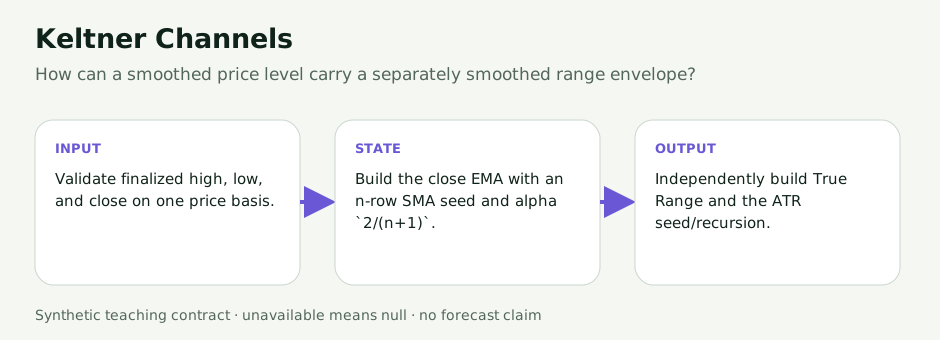
    A["Close stream"] --> B["SMA-seeded EMA"]
    C["High, low, previous close"] --> D["True Range"]
    D --> E["Wilder ATR"]
    B --> F{"Both states ready?"}
    E --> F
    F -- "no" --> G["Channel = null"]
    F -- "yes" --> H["EMA ± k × ATR"]
    I["Revision"] --> J["Recompute both recursive paths"]
How it works#
This page states the contract — how to call it correctly. The article explains the concept: why it works, and where it breaks.
References#
- Keltner Channels (KC) — TradingView
- New Concepts in Technical Trading Systems — J. Welles Wilder Jr.
- Average True Range — TA-Lib
- True Range — TA-Lib
- Public evidence boundary