Impulse-Response Analysis
Install and import#
npm install fintech-algorithmsimport { impulseResponses } from "fintech-algorithms/statistical-time-series/multivariate-systems/impulse-response-analysis";Signature#
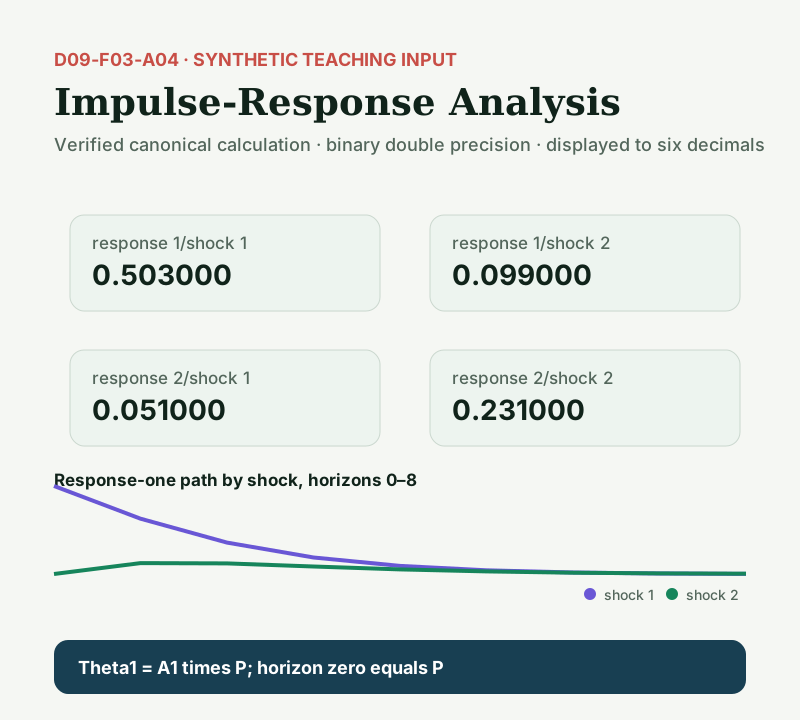
impulseResponses(coefficients, horizon, impactMatrix)Traces how a one-off shock to one variable propagates through the system over time. The headline output of any VAR — and only interpretable given the identifying assumption that produced the impact matrix.
Parameters#
| Name | Type | Notes |
|---|---|---|
coefficients | number[][] | VAR coefficient matrices. |
horizon | number | Periods to trace. min: 1 · integer: true |
impactMatrix | Matrix | Contemporaneous impact matrix. Defaults to the identity, so the responses are to unit shocks in each variable rather than to structurally identified ones. optional |
Returns#
{ responses, cumulative_responses, horizon, impact_matrix, companion_spectral_radius, stability_state, … }
Responses and their cumulative sums, plus the companion spectral radius — above 1 the system is explosive and the responses diverge rather than decay, which is stated instead of silently plotted.
Errors#
- When the coefficient matrices are not square or are inconsistent in dimension — throws
Complexity: time O(horizon × k³),
space O(horizon × k²).
Worked example#
executed Captured by running this function on the input its own test provides. Real output of real code — but not asserted against a published figure.
Input#
[
  [
    [0.55, 0.18],
    [-0.12, 0.42]
  ]
]8[
[0.8, 0],
[0.35, 0.55]
]Call#
impulseResponses(coefficients, horizon, impactMatrix)Returns#
object with 10 fields: responses, cumulative_responses, horizon, impact_matrix, companion_spectral_radius, stability_state, stability_boundary, near_boundary_threshold, …
{
"responses": [
[
  [0.8, 0],
  [0.35, 0.55]
],
[
[0.503, 0.099],
[0.051, 0.231]
],
[
[0.28583, 0.09603],
[-0.03894, 0.08514]
]
],
"cumulative_responses": [
[
[0.8, 0],
[0.35, 0.55]
],
[
[1.303, 0.099],
[0.401, 0.781]
],
[
[1.58883, 0.19503],
[0.36206, 0.86614]
]
],
"horizon": 8,
"impact_matrix": [
[0.8, 0],
[0.35, 0.55]
],
"companion_spectral_radius": 0.502593274925,
"stability_state": "stable",
"stability_boundary": 1,
"near_boundary_threshold": 0.9,
"state": "computed",
"reason": "ma-recursion-times-declared-impact"
}Other exports#
This module also exports
companionMatrix, companionSpectralRadius, fitVAR, choleskyLower, fitRecursiveSVAR, fitVECMFixedBeta, movingAverageMatrices, forecastErrorVarianceDecomposition. Every module additionally exports run as an alias of its
primary function, and a meta object carrying its catalog id, domain, family,
shape and article URL.
Diagrams#
Calculation flow#
Impulse-Response Analysis system flow
flowchart LR
    A["VAR coefficient matrices"] --> B["Phi zero equals identity"]
    B --> C["Moving-average recursion"]
    C --> D["Multiply by impact matrix"]
    D --> E["Response and cumulative paths"]
How it works#
This page states the contract — how to call it correctly. The article explains the concept: why it works, and where it breaks.
References#
- statsmodels vector autoregression documentation — statsmodels developers
- statsmodels Impulse-Response Analysis API documentation — statsmodels developers
- Generalized Impulse Response Analysis in Linear Multivariate Models — M. Hashem Pesaran and Yongcheol Shin
- New Introduction to Multiple Time Series Analysis — Helmut Lütkepohl
- Macroeconomics and Reality — Christopher A. Sims
- Statistical Analysis of Cointegration Vectors — Søren Johansen
- Publication boundary