Effective Number of Constituents
Install and import#
npm install fintech-algorithmsimport { calculate } from "fintech-algorithms/market-breadth-and-internals/concentration-and-diffusion/effective-number-of-constituents";Signature#
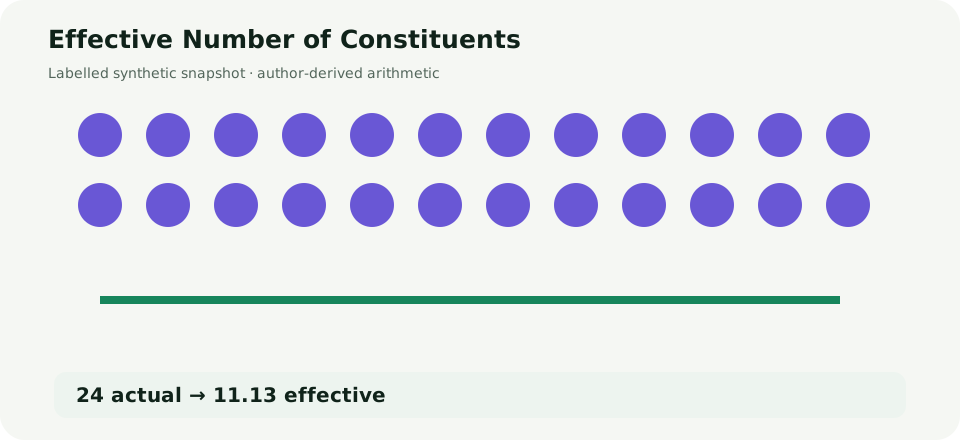
calculate(rows)The reciprocal of HHI: how many equally weighted holdings would give the same concentration. An index of 500 names with an effective number of 60 is, for risk purposes, a 60-stock portfolio.
Parameters#
| Name | Type | Notes |
|---|---|---|
rows | Row[] | Constituents with weights. Rows carry a ready flag; a row that is not ready is excluded rather than treated as zero, because a missing count and a count of zero mean opposite things about market breadth. |
Returns#
{ status, effective_n, actual_n, hhi }
The effective count beside the actual count — the gap between them is the entire message.
Errors#
- When weights do not sum to approximately 1 — reported as a status rather than thrown
Complexity: time O(n),
space O(1).
Worked example#
executed Captured by running this function on the input its own test provides. Real output of real code — but not asserted against a published figure.
Input#
[
  {
    "security_id": "S01",
    "weight": 0.17821782178217824,
    "return": 0.065,
    "sector": "Tech",
    "ready": true
  },
  {
    "security_id": "S02",
    "weight": 0.13861386138613863,
    "return": 0.041,
    "sector": "Financials",
    "ready": true
  },
  {
    "security_id": "S03",
    "weight": 0.10891089108910892,
    "return": 0.028,
    "sector": "Industrials",
    "ready": true
  }
]
Showing 3 of 24 elements.
Call#
calculate(rows)Returns#
object with 4 fields: status, effective_n, actual_n, hhi
{
  "status": "resolved",
  "effective_n": 11.134761062719665,
  "actual_n": 24,
  "hhi": 0.0898088422703657
}Diagrams#
Calculation flow#
Calculation Flow — Effective Number of Constituents
flowchart LR
    A["Point-in-time component snapshot"] --> B{"Complete, unique, finite?"}
    B -->|"No"| X["Incomplete — withhold value"]
    B -->|"Yes"| C["Apply Effective Number of Constituents contract"]
    C --> D["Retain component audit trace"]
    D --> E["Publish value, unit, parameter, and as-of"]
How it works#
This page states the contract — how to call it correctly. The article explains the concept: why it works, and where it breaks.
References#
- Claim-to-source map
- Herfindahl-Hirschman Index — U.S. Department of Justice, Antitrust Division
- Diversity and Evenness: A Unifying Notation and Its Consequences — Mark O. Hill
- S&P Dow Jones Indices: Index Mathematics Methodology — S&P Dow Jones Indices