KPSS
Install and import#
npm install fintech-algorithmsimport { kpss } from "fintech-algorithms/statistical-time-series/diagnostics/kpss";Signature#
kpss(values, lags, criticalValue)Tests stationarity with the null *reversed* relative to ADF: here the null is that the series is stationary. Running both is standard practice, because agreement is informative and disagreement tells you the sample cannot settle the question.
Parameters#
| Name | Type | Notes |
|---|---|---|
values | number[] | Observation series in chronological order, oldest first. |
lags | number | Bandwidth for the long-run variance estimator. min: 0 · integer: true |
criticalValue | number | Critical value at the chosen significance level. |
Returns#
{ method, variant, residual_mean, partial_sum_numerator, long_run_variance, statistic, decision, … }
The statistic with the long-run variance behind it, which is where the bandwidth choice shows up.
Errors#
- When the sample is shorter than the bandwidth requires — throws
Complexity: time O(n × lags),
space O(n).
Worked example#
executed Captured by running this function on the input its own test provides. Real output of real code — but not asserted against a published figure.
Input#
[0.49366418, 1.54242291, -0.82556495, 0.47513288, 0.50704417, -0.3816439]Showing 6 of 96 elements.
50.463Call#
kpss(values, lags, criticalValue)Returns#
object with 13 fields: method, variant, nobs, lags, residual_mean, partial_sum_numerator, long_run_variance, covariance_terms, …
{
  "method": "kpss",
  "variant": "level-stationary-fixed-bartlett-bandwidth",
  "nobs": 96,
  "lags": 5,
  "residual_mean": -2.0816681711721685e-17,
  "partial_sum_numerator": 0.2446756917455388,
  "long_run_variance": 4.82902222159472,
  "covariance_terms": [
    {
      "lag": 1,
      "weight": 0.8333333333333334,
      "cross_product": 102.29629606088473
    },
    {
      "lag": 2,
      "weight": 0.6666666666666667,
      "cross_product": 67.86612357881646
    },
    {
      "lag": 3,
      "weight": 0.5,
      "cross_product": 43.864068660314665
    }
  ],
  "statistic": 0.05066775022309546,
  "critical_value": 0.463,
  "reject_null": false,
  "state": "fail-to-reject-level-stationarity",
  "reason": "statistic-not-above-boundary"
}
Other exports#
This module also exports
acf, pacf, adf, ljungBox, zivotAndrews, runDiagnostic. Every module additionally exports run as an alias of its
primary function, and a meta object carrying its catalog id, domain, family,
shape and article URL.
Diagrams#
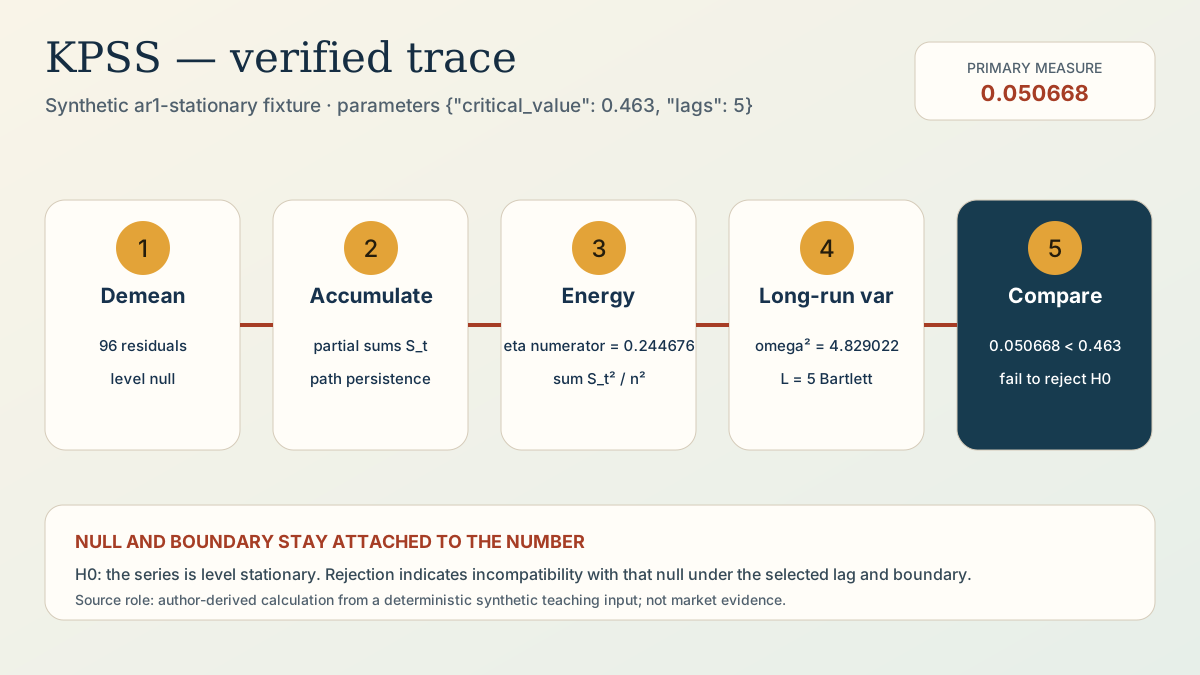
Calculation flow#
KPSS decision flow
flowchart TD
  A["Ordered finite series"] --> B{"Contract valid?"}
  B -- "No" --> X["Stop: explicit invalid state"]
  B -- "Yes" --> C["Demean for level null"]
  C --> D["Accumulate residual partial sums"]
  D --> E["Estimate Bartlett long-run variance"]
  E --> F["Compare KPSS statistic with boundary"]
  F --> G{"Declared strict decision rule"}
  G --> H["Report machine state, null, and limitation"]
  H --> I["Compare with Ljung-Box"]
How it works#
This page states the contract — how to call it correctly. The article explains the concept: why it works, and where it breaks.
References#
- Testing the null hypothesis of stationarity against the alternative of a unit root
- statsmodels.tsa.stattools.kpss
- Evidence decisions