Previous-Tick Interpolation
Install and import#
npm install fintech-algorithmsimport { previousTick } from "fintech-algorithms/market-data-engineering/time-synchronization/previous-tick-interpolation";Signature#
previousTick(observations, requests, maxStalenessMs)Samples a series onto a grid by carrying the last value known *at that moment* forward. The only interpolation that is safe on live data: it never uses a value that had not yet arrived.
Parameters#
| Name | Type | Notes |
|---|---|---|
observations | Observation[] | Observations carrying both event_time and available_time, which is what allows the as-of rule to be applied honestly. |
requests | { grid_time: string; query_time: string }[] | The grid points to sample, each with the knowledge time the answer must respect. |
maxStalenessMs | number | How old a carried-forward value may be before the sample is reported unusable rather than silently stale. min: 0 |
Returns#
Sample[] · length same-as-input
One sample per request with the value used, its age, and whether the staleness budget was met.
Errors#
- When maxStalenessMs is negative — throws
Complexity: time O(n + m),
space O(m).
Worked example#
executed Captured by running this function on the input its own test provides. Real output of real code — but not asserted against a published figure.
Input#
[
  {
    "instrument": "A",
    "event_time": "2026-01-02T14:30:00.100Z",
    "available_time": "2026-01-02T14:30:00.180Z",
    "revision": 0,
    "value": 100
  },
  {
    "instrument": "A",
    "event_time": "2026-01-02T14:30:00.100Z",
    "available_time": "2026-01-02T14:30:01.400Z",
    "revision": 1,
    "value": 99.8
  },
  {
    "instrument": "A",
    "event_time": "2026-01-02T14:30:02.200Z",
    "available_time": "2026-01-02T14:30:02.260Z",
    "revision": 0,
    "value": 100.4
  }
]
Showing 3 of 5 elements.
[
  {
    "grid_time": "2026-01-02T14:30:00.000Z",
    "query_time": "2026-01-02T14:30:00.000Z"
  },
  {
    "grid_time": "2026-01-02T14:30:01.000Z",
    "query_time": "2026-01-02T14:30:01.000Z"
  },
  {
    "grid_time": "2026-01-02T14:30:01.000Z",
    "query_time": "2026-01-02T14:30:02.000Z"
  }
]
Showing 3 of 5 elements.
1500Call#
previousTick(observations, requests, maxStalenessMs)Returns#
array of 10 objects
[
  {
    "instrument": "A",
    "grid_time": "2026-01-02T14:30:00.000Z",
    "query_time": "2026-01-02T14:30:00.000Z",
    "value": null,
    "source_event_time": null,
    "source_available_time": null,
    "source_revision": null,
    "staleness_ms": null,
    "status": "no_history"
  },
  {
    "instrument": "A",
    "grid_time": "2026-01-02T14:30:01.000Z",
    "query_time": "2026-01-02T14:30:01.000Z",
    "value": 100,
    "source_event_time": "2026-01-02T14:30:00.100Z",
    "source_available_time": "2026-01-02T14:30:00.180Z",
    "source_revision": 0,
    "staleness_ms": 900,
    "status": "carried"
  },
  {
    "instrument": "A",
    "grid_time": "2026-01-02T14:30:01.000Z",
    "query_time": "2026-01-02T14:30:02.000Z",
    "value": 99.8,
    "source_event_time": "2026-01-02T14:30:00.100Z",
    "source_available_time": "2026-01-02T14:30:01.400Z",
    "source_revision": 1,
    "staleness_ms": 900,
    "status": "carried"
  }
]
Showing 3 of 10 elements.
Diagrams#
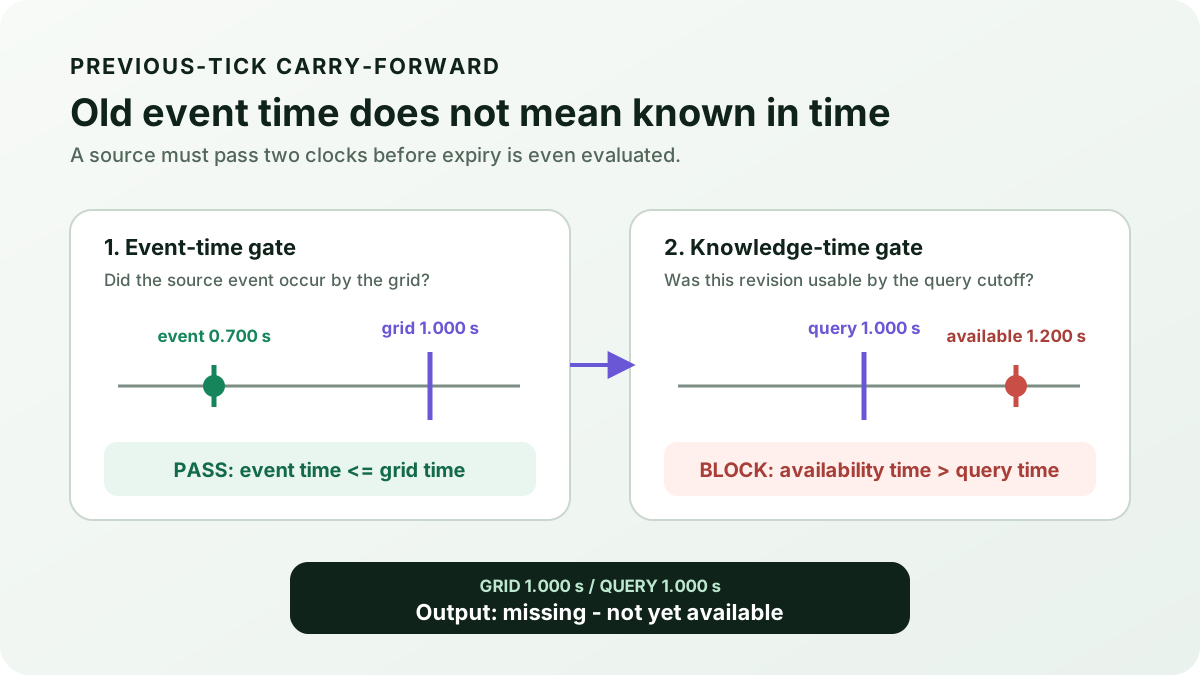
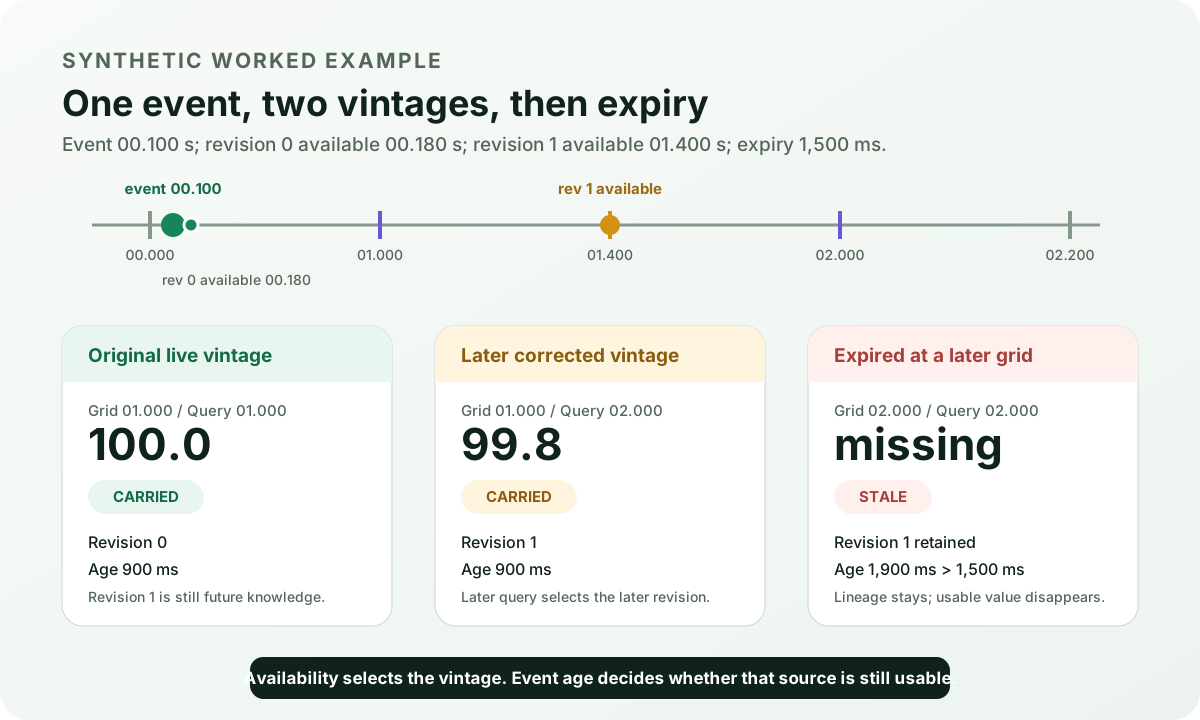
Calculation flow#
Point-in-time previous-tick decision
flowchart LR
    A["Stored source revisions"] --> B{"Event time <= grid time?"}
    B -->|No| C["No history"]
    B -->|Yes| D{"Availability time <= query time?"}
    D -->|No| E["Not yet available"]
    D -->|Yes| F["Latest event, latest available revision"]
    F --> G{"Source age <= expiry?"}
    G -->|Yes| H["Exact or carried value"]
    G -->|No| I["Stale missing value with lineage"]
How it works#
This page states the contract — how to call it correctly. The article explains the concept: why it works, and where it breaks.
References#
- R01 - RFC 3339: Date and Time on the Internet: Timestamps — Internet Engineering Task Force; G. Klyne and C. Newman
- R02 - On covariance estimation of non-synchronously observed diffusion processes — Takaki Hayashi and Nakahiro Yoshida
- R03 - NYSE Holidays and Trading Hours — New York Stock Exchange
- Implementation choices in this package
- Dataset and historical-evidence classification