Equal Risk Contribution
Install and import#
npm install fintech-algorithmsimport { equalRiskContributionWeights } from "fintech-algorithms/portfolio-construction/risk-allocation/equal-risk-contribution";Signature#
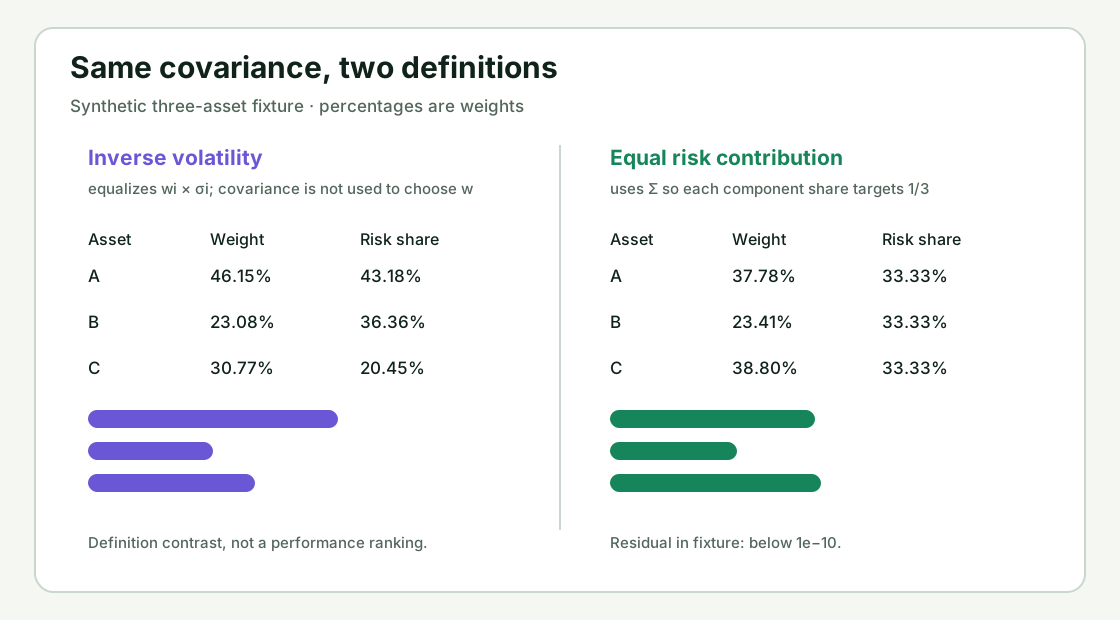
equalRiskContributionWeights(assetIds, covariance)Solves for the weights that give every asset the same contribution to portfolio volatility, which equal capital weights do not.
Parameters#
| Name | Type | Notes |
|---|---|---|
assetIds | readonly unknown[] | |
covariance | readonly unknown[] |
Worked example#
executed Captured by running this function on the input its own test provides. Real output of real code — but not asserted against a published figure.
Input#
["A", "B", "C"][
[0.01, 0.016, 0.0015],
[0.016, 0.04, -0.006],
[0.0015, -0.006, 0.0225]
]Call#
equalRiskContributionWeights(assetIds, covariance)Returns#
object with 13 fields: assetIds, weights, componentRiskContributions, componentRiskShares, portfolioVariance, portfolioVolatility, sumWeights, riskShareResidual, …
{
  "assetIds": ["A", "B", "C"],
  "weights": [0.3778302517370716, 0.23412526094592215, 0.3880444873170063],
  "componentRiskContributions": [0.031952220115817255, 0.03195222012249683, 0.031952220117888716],
  "componentRiskShares": [0.3333333333029024, 0.33333333337258536, 0.3333333333245123],
  "portfolioVariance": 0.00918849933464442,
  "portfolioVolatility": 0.0958566603562028,
  "sumWeights": 1,
  "riskShareResidual": 3.925204605792487e-11,
  "iterations": 20,
  "method": "equal-risk-contribution",
  "solver": "cyclical-coordinate-descent-volatility-eq7",
  "covarianceScale": 0.04,
  "status": "ok"
}Diagrams#
Calculation flow#
Diagram
flowchart TD
    A[Ordered asset IDs and covariance] --> B{Shape, finite, exact symmetry?}
    B -- no --> X[invalid-input or invalid-covariance]
    B -- yes --> C{Positive diagonal and strict PD?}
    C -- no --> X
    C -- yes --> D[Normalize by actual max absolute covariance]
    D --> E[Set y = ones and budget b = 1/N]
    E --> F[Cycle asset coordinates with volatility Eq. 7 positive root]
    F --> G[Compute covariance component shares]
    G --> H{Max share residual <= 1e-10?}
    H -- no, under 10000 sweeps --> F
    H -- no, at limit --> Y[convergence-failure]
    H -- yes --> I[Normalize y to fully invested weights]
    I --> J[Recompute variance, volatility, contributions, and shares from w]
    J --> K[Return ERC result and diagnostics]
How it works#
This page states the contract — how to call it correctly. The article explains the concept: why it works, and where it breaks.
References#
- Maillard, Roncalli, and Teïletche, “On the Properties of Equally-Weighted Risk Contributions Portfolios”
- Griveau-Billion, Richard, and Roncalli, “A Fast Algorithm for Computing High-dimensional Risk Parity Portfolios”
- Maillard, Roncalli, and Teïletche, SSRN record / DOI
- Palomar, Portfolio Optimization: Theory and Application, risk-based portfolios
- Prior input-integrity methods
- Claim and licensing boundary